The New EU Methane Regulation – An Overview of Deadlines, Requirements and Inspections
Key changes for the gas industry. Find out how they affect your operations.
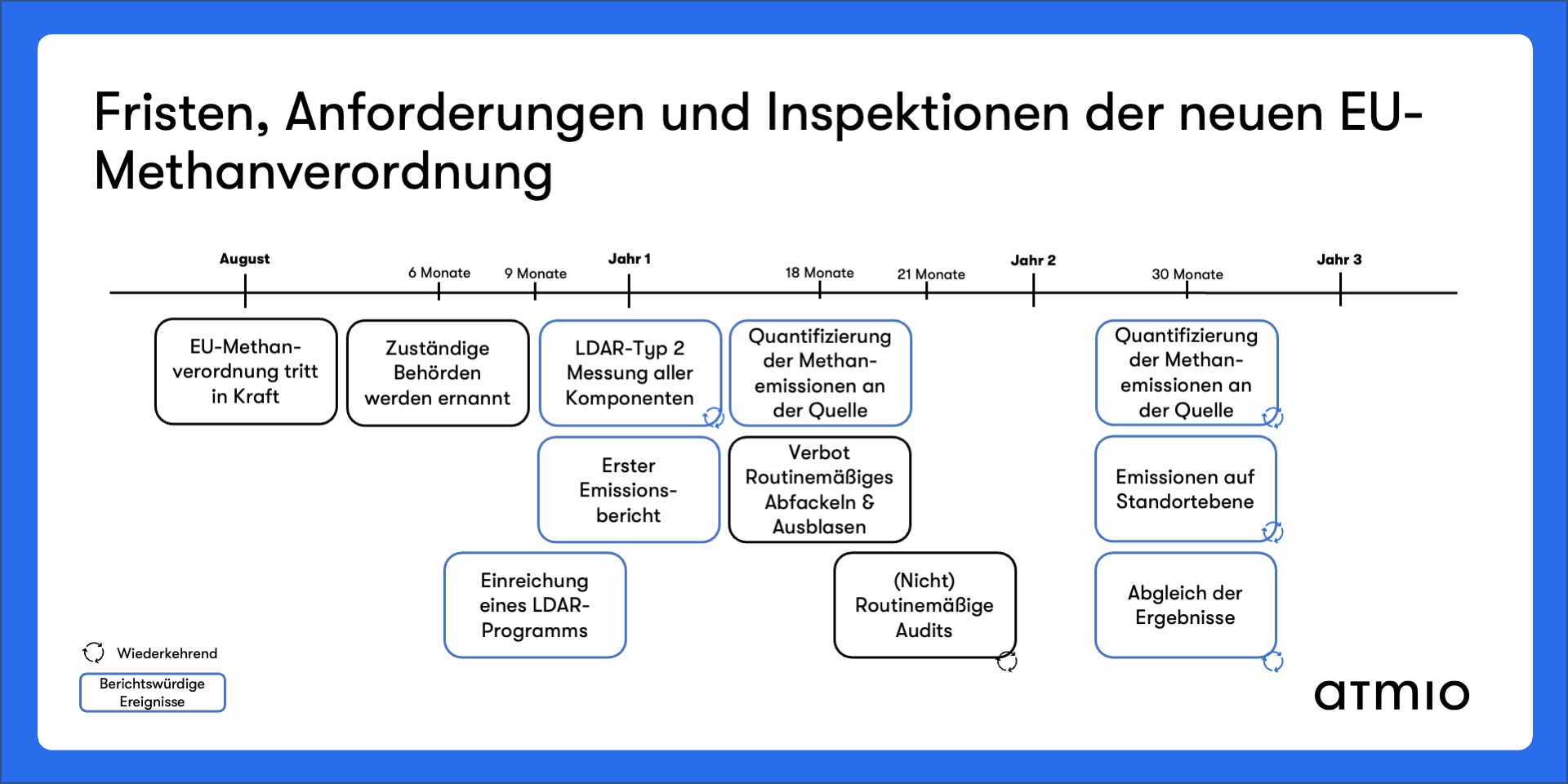
Welcome to our expert blog! Today we would like to present the timeline of the new EU Methane Regulation, which is of great importance for all operators in the gas industry. The aim of this regulation is to significantly reduce methane emissions and strengthen environmental protection. In this article, we explain the most important changes and requirements you need to be aware of.
Key deadlines
To give you a clear overview, here are the most important deadlines and milestones of the new Methane Regulation:
- 4 Aug 2024: EU Methane Regulation enters into force
- Feb 2025: Designation of the competent authorities (6 months after entry into force)
- May 2025: Submission of an LDAR programme (9 months after entry into force)
- Aug 2025: LDAR Type 2 survey of all components and quantification using generic emission factors (12 months after entry into force)
- Feb 2026: Source-level quantification of methane emissions and ban on routine venting and flaring (18 months after entry into force)
- May 2026: Routine and non-routine inspections (21 months after entry into force)
- Feb 2027: Source-level quantification of methane emissions, site-level emissions and reconciliation of the results (30 months after entry into force)
Operational requirements for gas operators
The regulation introduces a range of measures and requirements that gas infrastructure operators must implement:
Submission of an LDAR programme (May 2025)
Operators are required to submit an LDAR programme within 9 months of the regulation entering into force (Article 14(1)).
LDAR Type 2 survey of all components (Aug 2025)
Once the regulation has entered into force, operators must begin the first LDAR Type 2 survey of all components under their responsibility. This survey must be completed by July 2025 (Article 14(2)).
Ban on routine venting and flaring (Feb 2026)
Routine venting and flaring of methane is prohibited from January 2026 (Article 15(8)).
Reporting and monitoring
Reporting and monitoring of methane emissions is a key part of the new regulation:
Quantification of methane emissions using generic factors (Aug 2025)
By July 2025, operators must submit a report on estimated source-level methane emissions using generic emission factors (Article 12(1)). A generic emission factor is a standardised emission factor per emission source, taken from inventories or databases but not verified by direct measurement.
Source-level quantification of methane emissions (Feb 2026)
By January 2026, operators must quantify methane emissions at source level and submit the corresponding reports (Article 12(2)). This involves measuring methane emissions at source using a measurement method that allows such a measurement.
Source-level quantification, site-level emissions and reconciliation of the results (Feb 2027)
By January 2027, operators must submit reports on site-level methane emissions and reconcile them with the aggregated source-level methane emission measurements (Article 12(3)).
Inspections by the authorities
Operators will be subject to both routine and non-routine checks by the competent authorities. During these inspections, the authorities visit sites and check documents and records to ensure compliance with the rules. The authorities also check the measurement method and methane emissions and take any further measures necessary to monitor and promote compliance with the regulation.
Routine and non-routine inspections (May 2026)
The first routine inspection will be completed by April 2026. After that, the competent authorities will draw up programmes for routine inspections based on a risk assessment (Article 6(3)).
In addition, non-routine inspections will be carried out to ensure that leak repairs and component replacements are carried out in accordance with the rules and that emission reduction measures are implemented (Article 6(4)(b)).
Conclusion
The new EU Methane Regulation brings numerous changes and requirements for the gas industry. It is crucial that operators take the necessary measures early on to meet the deadlines and comply with the new rules. We are happy to provide further information and support.
More articles