Article 12 EU Methane Regulation – "Monitoring and Reporting"
General requirements, deadlines and effort estimate for operators
Welcome to our expert blog! Today we would like to give you a detailed insight into Article 12 of the new EU Methane Regulation, which is of central importance for all operators in the gas industry. In this article, we explain the most important deadlines and requirements you should know about.
General operational requirements and reporting
Article 12 of the EU Methane Regulation sets strict requirements for reporting and monitoring methane emissions. Operators must make sure they take the following measures:
- Submission of methane reports: These reports must not only use generic emission factors but also include source-level measurements. This helps to improve data accuracy and gives a better understanding of actual emissions.
- Regular monitoring: Operators are expected to monitor their methane emissions continuously and use this data for further analysis and reporting.
- Reconciliation of the results: The data from the different measurement methods must be reconciled to ensure that methane emissions are correctly captured and reduced at all levels (from February 2027).
Key deadlines from Article 12
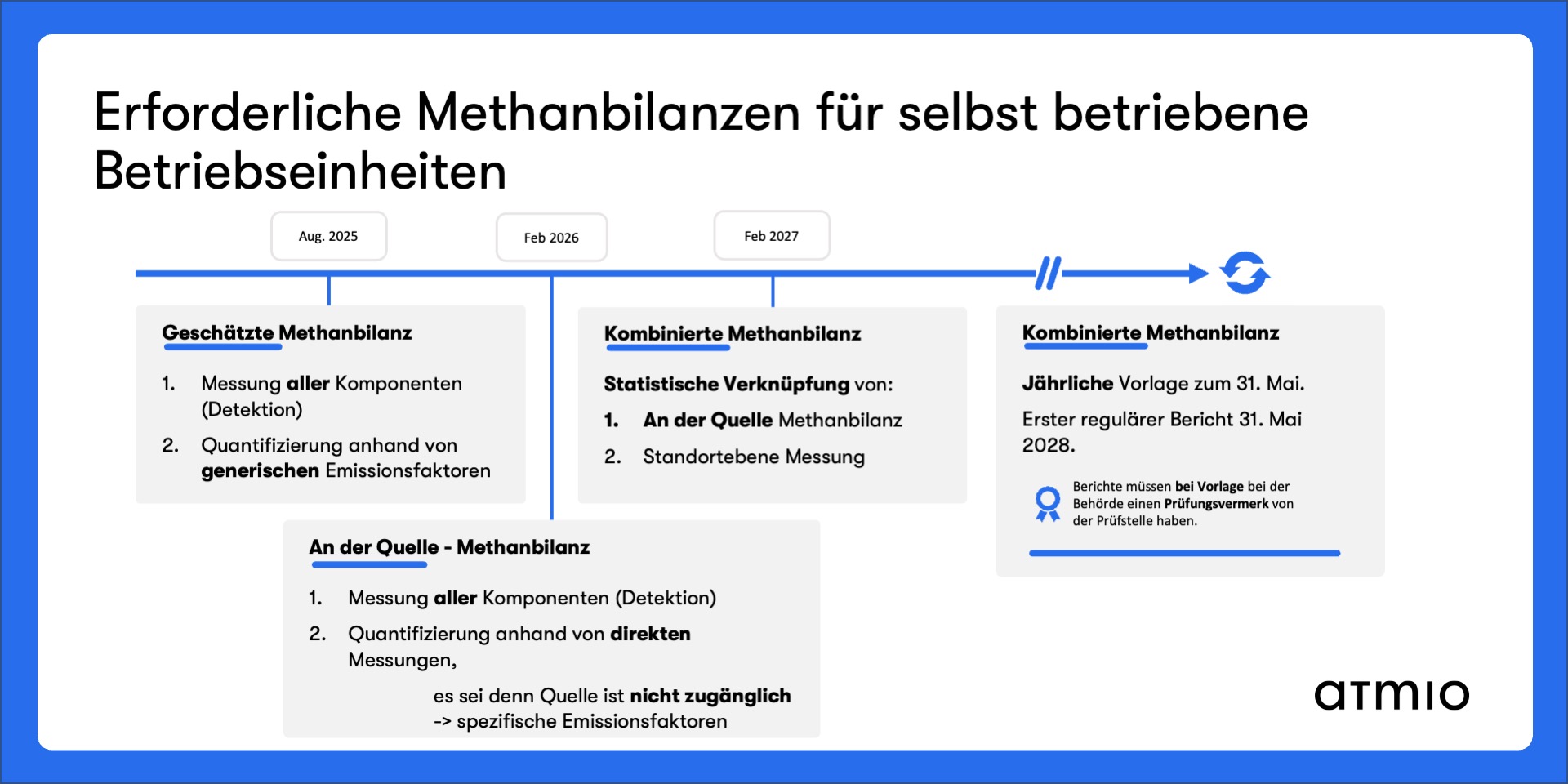
- August 2025: Operators must submit an estimated methane inventory based on generic emission factors. These reports are intended to provide an initial assessment of methane emissions and serve as a basis for further measures (Article 12(1)).
- February 2026: Operators must submit detailed reports on quantified source-level methane emissions. These reports require direct measurements of methane emissions and provide a more precise basis for monitoring and controlling emissions (Article 12(2)).
- February 2027: Operators must submit a report to the competent authorities that quantifies source-level methane emissions and is complemented by site-level measurements – the so-called combined methane inventory (Article 12(3)).
Effort estimate for operators
For operators in the gas industry, the new requirements mean considerable effort due to extensive paperwork and reporting, as well as the need for analytical capabilities to reconcile different measurement inventories. Regular detailed reports and direct source-level measurements increase the administrative workload. The requirements call for technical know-how to validate the data sources. The actual effort varies greatly depending on the size and structure of the operation, which is why an individual assessment is essential. That is why we are happy to be your partner and support you in meeting the requirements of the EU Methane Regulation efficiently and reliably.
Conclusion
The new EU Methane Regulation brings numerous changes and requirements for the gas industry. It is crucial that operators take the necessary measures early on to meet the deadlines and comply with the new rules. We are happy to provide further information and support.
More articles