New EU Methane Regulation: Detailed Frequency Requirements for the Gas Industry in Article 14
Strict frequency requirements: what operators need to know and do now to comply with the rules
With the new EU Methane Regulation in force, operators in the gas industry face a wide range of new challenges. In particular, the frequency requirements for leak detection and repair measures set out in Article 14 (LDAR programme) bring complex and specific obligations. Methane emissions are an environmental problem, and the regulation aims to reduce them significantly. Operators therefore need to adapt their existing processes to meet the new requirements.
Why the new inspection frequencies matter
The frequency of surveys varies depending on the type of site, the material and the design pressure. In this article, we give an overview of the inspection frequencies for different areas of application, including underground storage facilities and distribution and transmission system operators.
LDAR surveys are divided into two main categories
- LDAR Type 1: These inspections are carried out more frequently and aim to detect larger leaks (min. 7,000 ppm or 17 g/h) at an early stage (Art. 1(26)).
- LDAR Type 2: These inspections take place at longer intervals and focus on more comprehensive and complex surveys to find smaller leaks as well (500 ppm or 1 g/h, or 1,000 ppm or 5 g/h for underground components) (Art. 1(27)).
Note: LDAR Type 1 surveys can be replaced by Type 2 surveys.
Frequencies for operators outside the definition of distribution and transmission networks
For all above-ground and underground components, except distribution and transmission networks, LDAR surveys must be carried out at least at the following intervals:
Compressor stations, underground storage facilities, LNG facilities and regulating & metering stations: the interval is 4 months for Type 1 inspections and 8 months for Type 2 inspections.
Valve stations: here the interval is 9 months for Type 1 and 18 months for Type 2 (Annex I, Part 1, point 1).

Frequencies for distribution and transmission networks
Specific requirements apply to distribution and transmission networks, which additionally take into account the design pressure and materials of the assets.
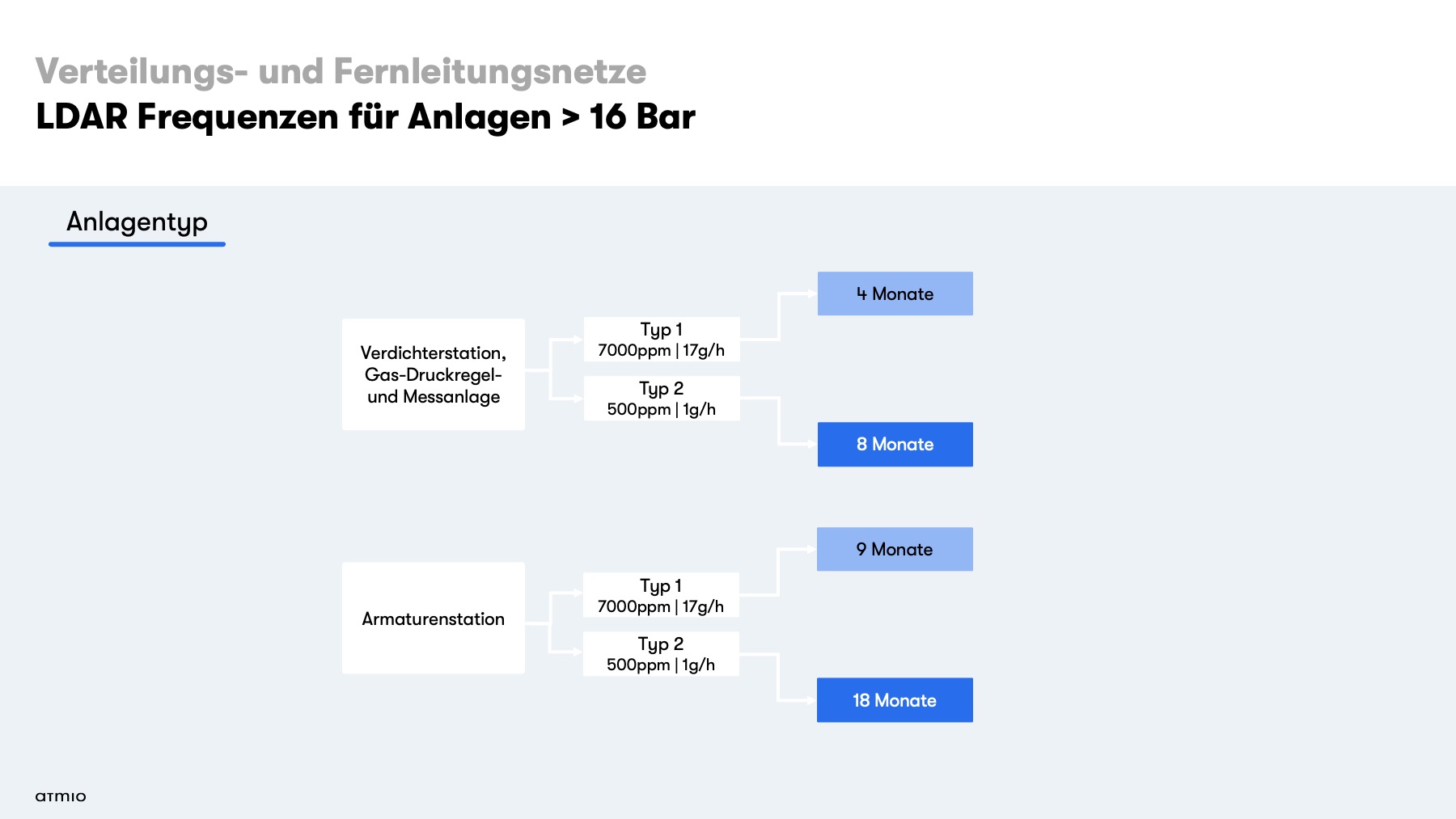
Assets with a design pressure above 16 bar
If the design pressure is above 16 bar, compressor stations and regulating & metering stations must be surveyed every 4 months (Type 1) or every 8 months (Type 2). Valve stations at this pressure have longer intervals: 9 months for Type 1 and 18 months for Type 2 (Annex I, Part 1, point 2).
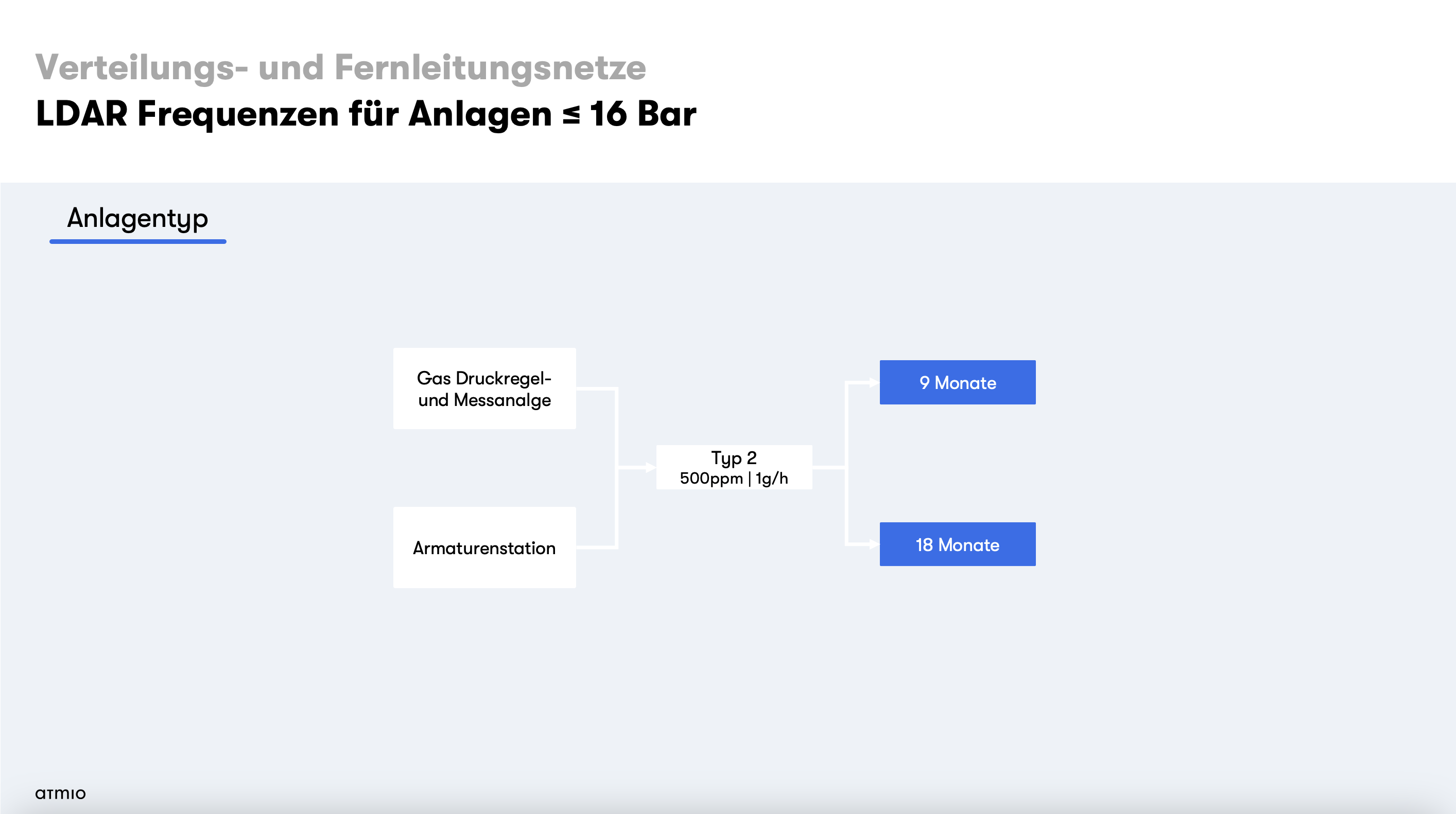
Regulating & metering stations with a design pressure of 16 bar or less
If the design pressure does not exceed 16 bar, a Type 1 survey is not required. For these stations, only a Type 2 survey every 9 months is required. Valve stations with a design pressure of 16 bar or less must be checked with a Type 2 survey every 21 months.
Frequencies for pipelines
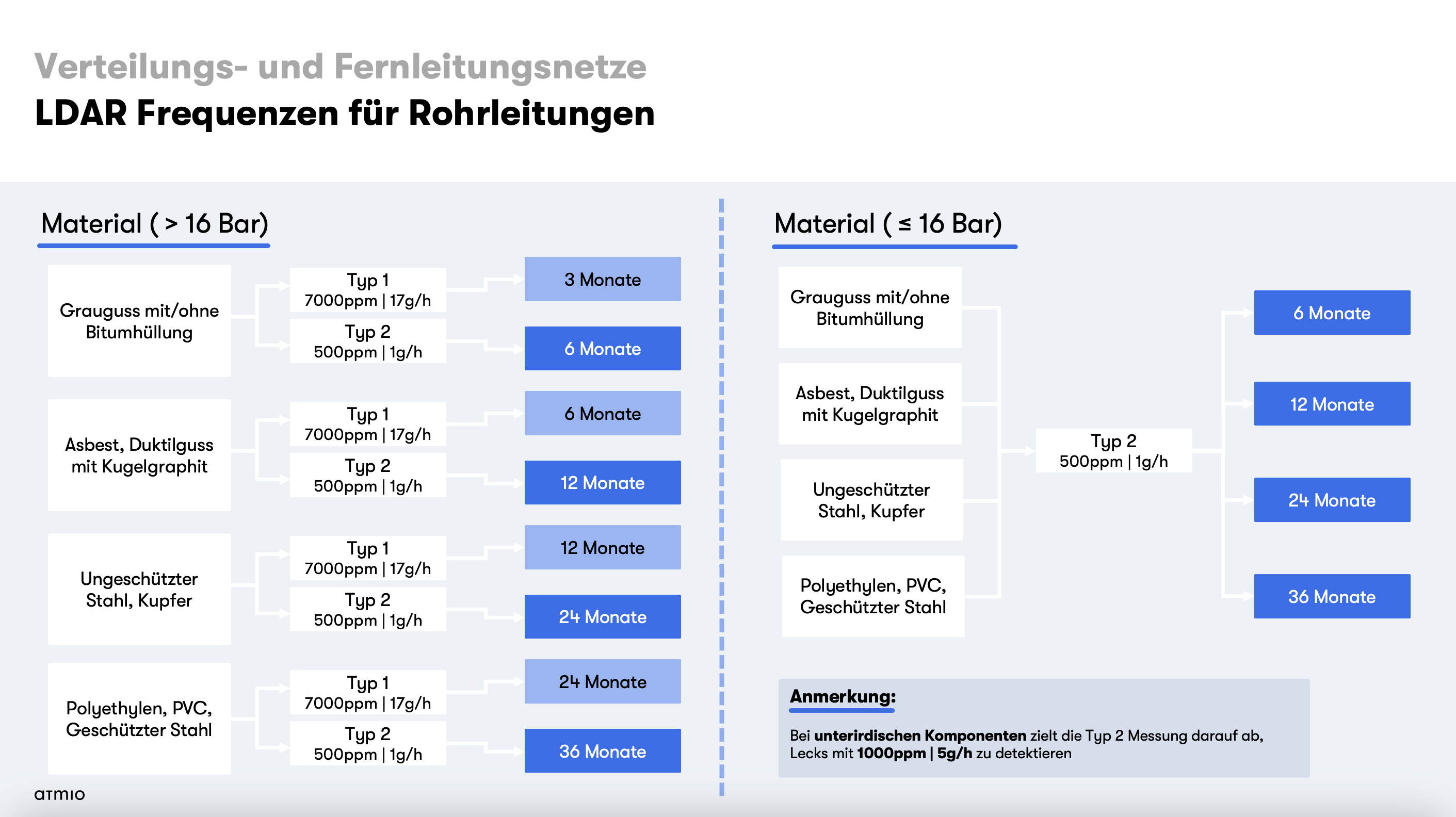
The inspection frequencies for pipelines depend on the material used. For example, grey cast iron or asbestos pipelines with a design pressure above 16 bar require more frequent inspections. At lower pressures or for other materials, the inspection intervals are correspondingly longer, which means maintenance schedules need to be adjusted (Annex I, Part 1, point 2). The exact frequencies can be found in the table.
Conclusion
The EU Methane Regulation poses new challenges for the gas industry, in particular through the inspection frequencies in Article 14. Operators need to adapt their inspection plans and staff capacities in a targeted way to meet the different requirements. The regulation calls for a precise and structured approach that not only ensures compliance but also contributes to long-term operational safety and environmental protection.
atmio understands the complexity of these tasks and offers support to help you meet the new rules efficiently. Get in touch with us to find out more.
More articles