Article 14 LDAR Programme: New Requirements for Leak Detection and Repair under the EU Methane Regulation
Find out more about the new LDAR requirements of the EU Methane Regulation and what you need to consider
With the new EU Methane Regulation, the European Union is taking an important step towards reducing methane emissions and protecting the environment. The regulation particularly affects operators in the gas industry, who now have to comply with stricter rules on leak detection and repair (LDAR). The relevance of these new rules lies not only in better environmental protection, but also in the potential economic impact for companies, which can save costs and avoid penalties by detecting and repairing methane leaks early.
Today we would like to give you an insight into Article 14 of the new EU Methane Regulation, which focuses on leak detection and repair (LDAR). This provision is crucial for all operators in the gas industry in order to reduce methane emissions and strengthen environmental protection. In this article, we explain the objectives of the LDAR programme and the timeline of the corresponding requirements.
Detect and repair: the main objectives of the LDAR programme
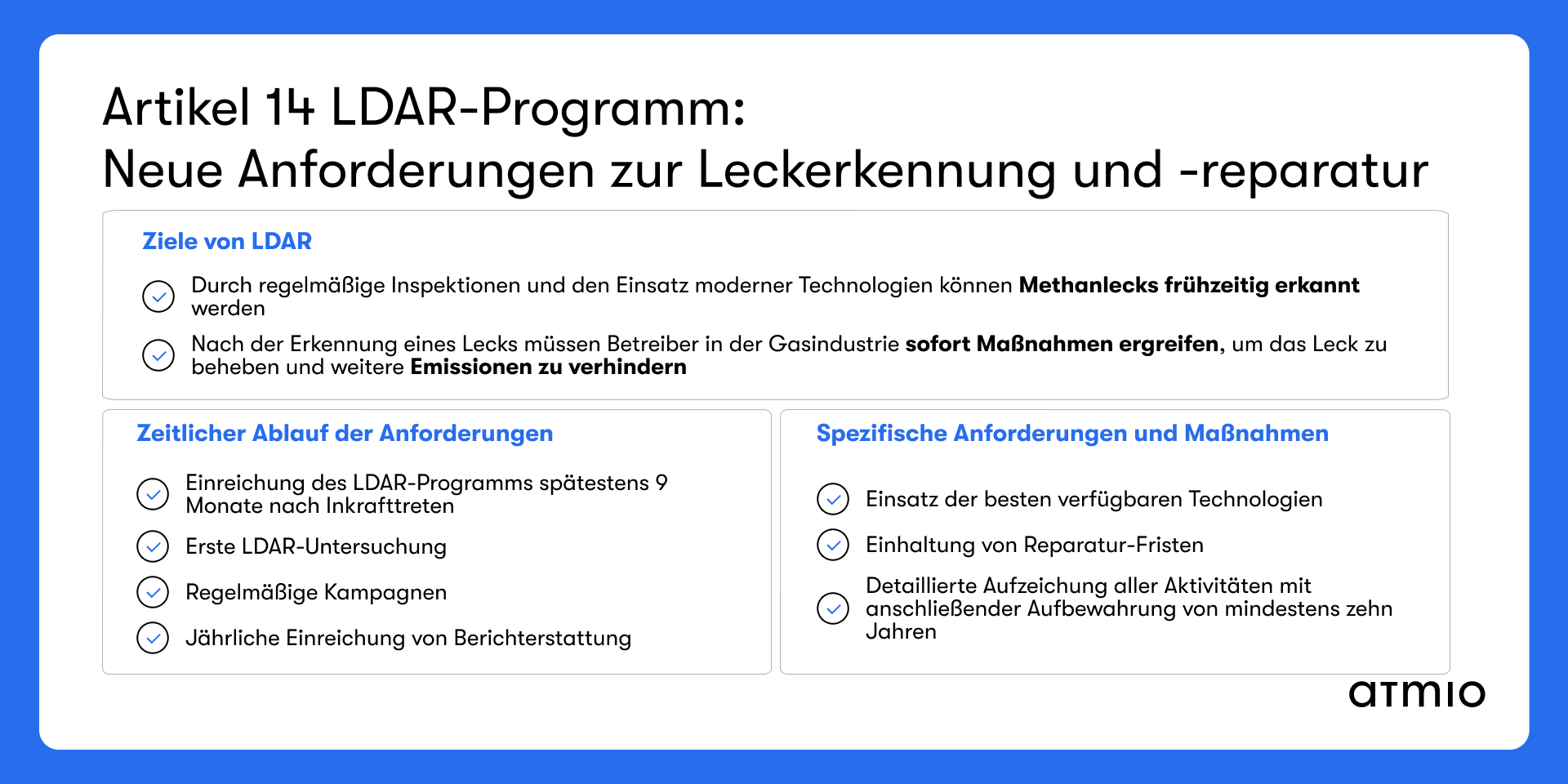
The main objective of the LDAR programme is to detect methane leaks in energy infrastructure early and repair them quickly. An effective LDAR programme ensures that:
Leaks are detected early: Regular inspections and the use of modern technologies allow methane leaks to be identified promptly (Art. 14(2)).
Repairs are carried out quickly: Once a leak has been detected, operators must take immediate action to repair it and prevent further emissions (Art. 14(8) f.).
Timeline of the LDAR requirements
The EU Methane Regulation sets clear deadlines for implementing and complying with the LDAR programme. These deadlines are crucial to ensure that gas network operators can take the necessary measures in time. Here are the most important points to bear in mind:
1. Submission of the LDAR programme
Rules for existing sites: operators must submit a detailed LDAR programme to the competent authorities no later than nine months after the regulation enters into force (Art. 14(1)).
2. First LDAR survey
Gas network operators must start the LDAR surveys as soon as possible after the regulation enters into force (4 August 2024) and complete them within 12 months (Art. 14(2)).
3. Regular LDAR campaigns
Operators must carry out LDAR campaigns at their sites at regular intervals. The frequencies depend on various criteria, for example the design pressure of regulating & metering stations, the material of pipelines or the type of site, such as a compressor station (Annex I, Part 1). (We explain the deadlines and methane emission thresholds for LDAR surveys in detail in our article on frequency requirements under Article 14.)
4. Reporting and documentation
Operators in the gas industry are required to submit an annual report to the competent authorities summarising the results of all LDAR surveys carried out in the previous year, together with all repair and monitoring schedules (Art. 14(14)).
Specific requirements and measures for gas industry operators
The regulation sets high standards and requires targeted measures to reduce methane emissions effectively. Let's look at the specific measures you need to take:
- LDAR methods and technologies: For repairs or replacements, the best available technologies on the market must be used. These modern technologies are meant to provide long-term protection against future leaks while offering maximum efficiency and sustainability in leak prevention (Art. 14(9)).
- Leak repair: Leaks are first assessed according to their size. If a leak exceeds the defined threshold of, for example, 500 ppm, it must be repaired within a set period of initially five and at most 30 days after detection (Art. 14(8) f.). Deviations from the repair deadlines can be decided on the basis of defined exceptions. Smaller leaks must be checked regularly for changes as part of a monitoring programme.
- Documentation and records: Operators must keep detailed records of all LDAR activities. These records must be kept for at least ten years and made available to the competent authorities on request (Art. 14(13)).
Conclusion
The LDAR requirements of the new EU Methane Regulation are an essential step towards reducing methane emissions in the gas industry. Operators must make sure they take the necessary measures early on to detect and repair leaks and avoid penalties. This includes using state-of-the-art technologies, regularly checking all sites and carefully documenting all activities – the latter being the foundation of all reports and analyses.
To fully meet the complex requirements of the regulation, an individual assessment is helpful. atmio is at your side and supports you in implementing the new rules. With our extensive expertise and tailored solutions, we help you maximise the efficiency of your LDAR programmes while promoting environmental protection. Arrange a personal meeting with us to find out more about how we can help you successfully meet the new requirements.
More articles