Repair Requirements and New Challenges in Dealing with Methane Emissions
Learn more about the new repair requirements
The new EU Methane Regulation introduces binding measures for the oil and gas industry to detect and eliminate methane emissions as part of the leak detection and repair (LDAR) programme. The regulation builds on proven practices such as OGMP 2.0, but sets considerably stricter requirements for methane mitigation. A key aspect is the repair process, which is regulated in detail in Article 14. This article describes the process of leak detection, repair and the monitoring of the measures taken.
The LDAR (leak detection and repair) programme is an important part of the new EU Methane Regulation. It obliges operators to carry out regular inspections of their sites in order to identify methane leaks and repair them promptly.
Leaks above the repair thresholds
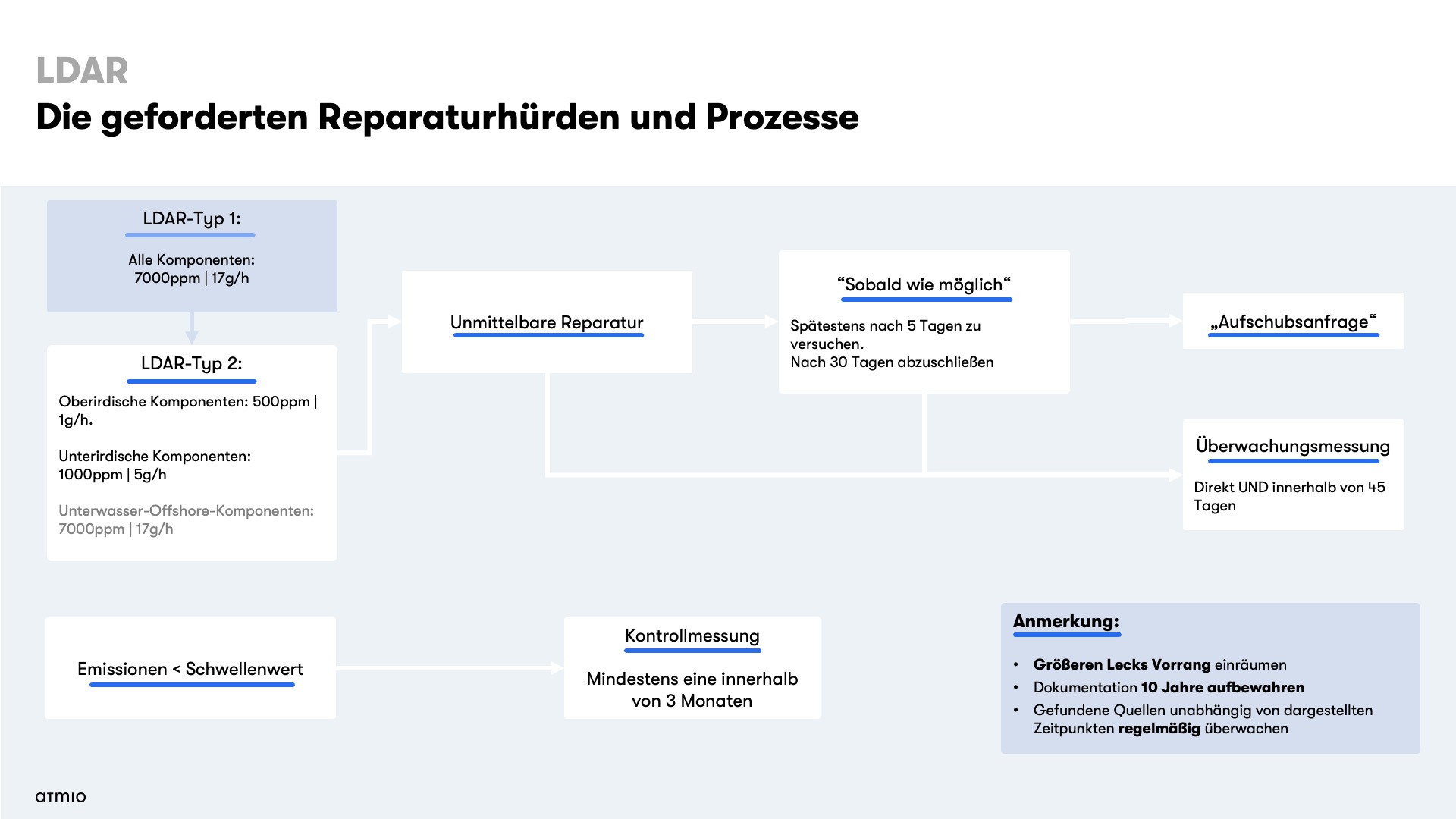
The regulation sets a repair threshold of 500 ppm or 1 g/h for above-ground components and 1,000 ppm or 5 g/h for underground components, while subsea offshore components are subject to a threshold of 7,000 ppm or 17 g/h. (Art. 14(8))
The repair process is clearly defined: as soon as a leak above the respective repair threshold is detected, it must be repaired immediately. If immediate repair is not possible, a first repair attempt must be made within 5 days and the repair must be completed within 30 days at the latest. In exceptional cases, the regulation allows a delay, which the operator must justify in a request to the competent authorities and which must be approved. The regulation lists various reasons for this, which have to be assessed case by case. (Art. 14(9))
Leaks below the repair threshold
Leaks below the respective repair thresholds, e.g. 300 ppm for above-ground components, do not have to be repaired immediately. These leaks must be checked every three months in monitoring campaigns to ensure that the condition of the leak does not deteriorate. If a leak exceeds the respective repair threshold, the same process applies as for leaks above the repair threshold.
Validation, prioritisation and long-term documentation
Another aspect of the new regulation is the follow-up after a repair. At least two monitoring measurements must be carried out: one check directly after the repair and another within 45 days. These checks are necessary to ensure that the leak has been fully eliminated and that the repair is lasting. (Art. 14(12)(a))
The new regulation also stresses that larger leaks with a higher emission potential must be prioritised. Operators are required to document their measures, report them to the authority and retain these records for at least 10 years. This ensures traceability and long-term transparency. (Art. 14(13))
Conclusion
The EU Methane Regulation sets clear thresholds for leak detection and prescribes strict repair deadlines. The focus is on immediate repair and long-term monitoring, so that methane emissions are not only reduced in the short term but minimised permanently. The clear prioritisation of larger leaks and the regular checks help operators comply with the new regulation and contribute to climate protection.
For companies, this means an administrative and organisational challenge. It requires a systematic approach and the implementation of effective systems that significantly reduce the workload on the operator side.
More articles