
Measured twice, gained little?
Why site-level measurements at regulating & metering stations should be rethought
Which measurements does the EU Methane Regulation require?
The EU Methane Regulation (Regulation (EU) 2024/1787), hereinafter referred to as the “MER”, sets clear requirements for operators: by 5 February 2027, operators of operated assets must meet their reporting obligation and not only quantify their methane emissions at source level, but also complement and reconcile them with site-level measurements.
In a project with a distribution system operator (DSO) in northern Germany, we examined what site-level measurement looks like in practice at regulating & metering stations (known in Germany as GDRM stations). In the process, we learned a lot about the limits of the method.
What are site-level and source-level measurements?
When it comes to measuring methane emissions, the MER distinguishes between two levels: source level and site level. Source-level measurements are taken directly at individual components such as flanges, screw fittings or regulators; the results of LDAR Type 2 surveys are often used for this. Site-level measurements, by contrast, are intended to capture a site as a whole. This is also referred to as a “top-down measurement” (or site-level measurement or site-level quantification).
Individual components
Measurement directly at flanges, screw fittings or regulators – often based on the LDAR Type 2 survey.
The site as a whole
Top-down measurement, also known as site-level measurement or site-level quantification.
The results of both measurements are then compared in a reconciliation. If the quantified emission values overlap within their measurement uncertainties, the emissions inventory is considered confirmed. The idea behind this comes from the OGMP 2.0 framework: an independent second measurement is meant to show that no significant emission sources have been overlooked. According to the OGMP guidance, source-level and site-level measurements must therefore be carried out using independent methods or technologies; a single measurement campaign cannot meet both requirements (OGMP 2.0 Uncertainty & Reconciliation Guidance, p. 13). The MER sets out the same objective in binding terms: source-level measurements are complemented by site-level measurements so that the source-level estimates aggregated per site can be assessed and compared (Art. 12(3)).
It is important to distinguish this from LDAR (leak detection and repair), because the two measurements stem from different parts of the regulation and serve different purposes. LDAR under Art. 14 is a process for mitigating fugitive emissions: leaks are searched for and repaired above the repair threshold. Depending on the component, these surveys are required every 3 to 15 months (Type 1) or every 6 to 30 months (Type 2). Site-level measurement, on the other hand, is part of reporting under Art. 12. It quantifies the total emissions of a site in order to validate the reported emissions inventory.
Mitigation
Search for leaks and repair them above the repair threshold – Type 1 every 3 to 15 months, Type 2 every 6 to 30 months.
Validation
Quantify the total emissions of a site in order to validate the reported emissions inventory.
Site-level measurement is therefore primarily a validation tool. However, this validation also works by having the site-level measurement uncover emission sources that are missing from the source-level inventory (Schissel 2024, p. 115 f.). If the site-level measurement is significantly higher than the sum of the source-level measurements, it is very likely that there are emissions missing from the source-level inventory. Pinpointing and subsequently repairing these leaks is not possible with site-level measurements, however; this is where LDAR or source-level measurement technology comes in.
How do you measure methane emissions at a regulating & metering station?
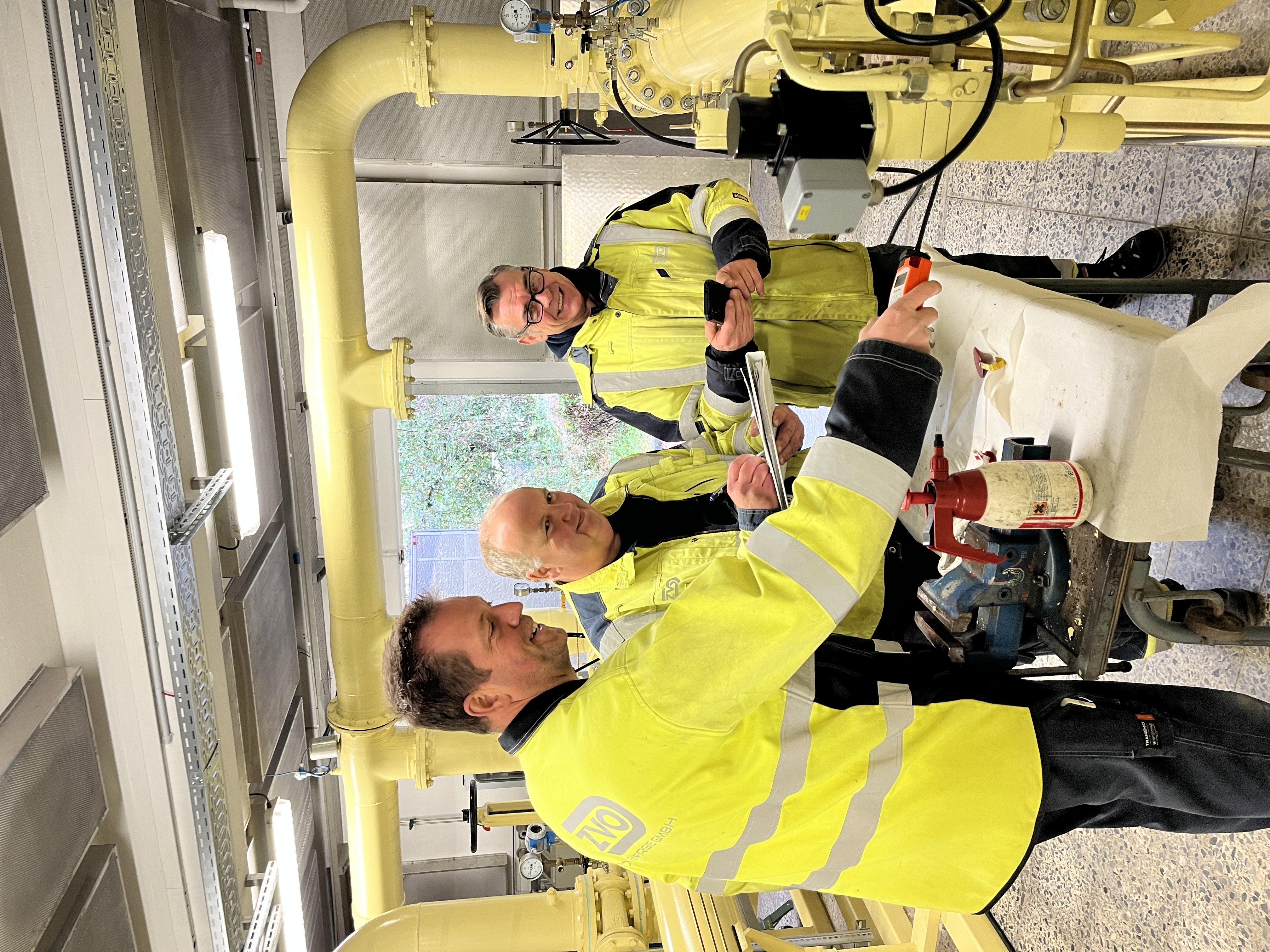
Together with a measurement service provider, we collected data at both measurement levels at twelve regulating & metering stations. For the source-level measurement, all accessible components were checked by contact measurement. Any leaks found were quantified directly with a handheld device.
For the site-level measurement, the extraction method according to DVGW G 425-3 was used, known as “bagging”. The name comes from its classic application: a cover is placed over an individual component, and the gas escaping inside it is extracted and measured. At a regulating & metering station, this principle is applied to the entire building. The bagging probe is placed tightly over the building’s ventilation opening; the pump integrated into the measuring device draws the indoor air through the probe. The device measures the methane concentration and calculates an emission rate from the concentration and the volume flow. The measurement was carried out exactly according to the manufacturer’s instructions, which describe this setup as a standard-compliant solution according to G 425-3.
For the method to work, however, the pump must exchange the indoor air often enough – otherwise only part of the escaping methane reaches the probe at all. We will come back to this below.
One special case quickly stood out: the vents. These route gas, e.g. from the safety relief valves, to the outside via a separate line. Extracting the building’s indoor air by bagging does not capture the outlets of these installations at all.
Special case vents: are they part of the site-level measurement?
Site-level measurements are meant to capture all emissions of a site; vents should therefore actually be included in the site-level measurement as well.
Currently, vents are often measured individually at their outlet with a high-flow sampler or a conventional handheld device – in other words, with source-level measurement technology. For a meaningful reconciliation, source-level and site-level measurements must be carried out using independent methods. If you measure the same vent with the same technology and assign the result to both the site-level and the source-level measurement, it simply cancels out in the reconciliation: the value would appear on both sides and could therefore neither confirm nor refute anything. If the vent emissions were added only to the site level and left out at the source level, you would effectively be creating a one-sided measurement discrepancy on purpose, which would distort the subsequent reconciliation.
Strictly speaking, this means that an additional measurement technology would have to be used, such as an optical gas imaging camera with quantification (QOGI). The vents could then, for example, be quantified at source level with a handheld device and at site level with the camera.
Assuming that, in practice, these measurements are carried out within a few minutes of each other, however, both should deliver the same result. Any deviations could then at most be attributed to the measurement technology or how it is handled, not to additional emissions. Both the effort and the insight gained are questionable. Nor can the site-level measurement uncover emissions missing from the source-level inventory here, since both measurements are taken at the same, already known outlets of the vents.
Our approach
How vents should sensibly be handled in the context of reconciliation is still unclear. For the reasons above, we leave them out of the reconciliation. However, they are still measured and recorded as source-level measurements in the source-level inventory (Level 4 according to OGMP 2.0), so that they are included in the emissions report and the site’s emissions are fully represented.
The result: formally not reconciled, but no gap in the inventory
At ten of the twelve stations, source-level and site-level measurements matched – albeit in the most unspectacular way possible: both sides show 0 g/h. At two stations, the source-level measurement found small leaks of 0.04 g/h and 0.6 g/h, while the site-level measurement found nothing.
Match
Source-level and site-level measurements both show 0 g/h.
Formally not reconciled
Source-level measurement: 0.04 g/h and 0.6 g/h – site-level measurement: 0 g/h.
Formally, these two sites therefore cannot be reconciled: the emission totals from the source-level and site-level measurements do not overlap within their respective uncertainty intervals. There is no indication of an incomplete inventory, though, because the source-level measurement found more than the site-level measurement, not less. We see two causes for the discrepancy: one related to measurement technology and one methodological.
We attribute the fact that the site-level measurement consistently showed 0 g/h mainly to insufficient air exchange. G 425-3 requires the extraction to exchange the room volume at least three times per hour. However, the integrated pump of our measuring device only delivered around 110 litres per hour. That is enough for a space of about 37 litres – roughly the volume of a beer crate. Even for a small station of 2–3 m³, a volume flow 55 to 80 times higher would have been needed.
The measurements were taken exactly in line with the device’s operating manual, which explicitly provides for its use at regulating & metering stations according to G 425-3. However, it contains no reference to the required air exchange or to an additional blower. The limitation only becomes apparent when you read the standard in detail. Anyone commissioning or carrying out bagging measurements should therefore pay particular attention to this. In our next measurements, we will use an additional blower and are curious to see whether such small leaks can then be reliably detected.
On top of this comes a methodological problem with the reconciliation itself, which exists independently of the measurement technology. This is easy to calculate. A measurement uncertainty of 11.5% was assumed for the measurements. This means that the range of acceptable deviations for the source-level measurement extends from 0.035 to 0.045 g/h at one station (0.04 g/h ± 11.5%) and from 0.53 to 0.67 g/h at the other (0.6 g/h ± 11.5%). Even with a considerably higher uncertainty of, say, 50%, the lower bound would be 0.02 g/h (0.04 g/h minus 50%) or 0.3 g/h (0.6 g/h minus 50%) – still above the site-level value of 0 g/h. Mathematically, an overlap would only be reached at an uncertainty of 100%, assuming that the site-level measurements of 0 g/h have no measurement uncertainty.
| Station | Source-level measurement | Range at ± 11.5% | Lower bound at − 50% | Site-level measurement |
|---|---|---|---|---|
| Station A | 0.04 g/h | 0.035–0.045 g/h | 0.02 g/h | 0 g/h |
| Station B | 0.6 g/h | 0.53–0.67 g/h | 0.3 g/h | 0 g/h |
The operating manual of the measuring device used does not state a detection limit for the bagging setup. If the specified sensor accuracy is used instead as the uncertainty of the zero measurement, there is still no overlap.
On paper, this means there are “statistically significant” discrepancies. According to the MER (Art. 12(6)), the competent authority would have to be informed of these discrepancies in this case; further re-measurements could be ordered. However, the measured emissions are below the applicable repair threshold (500 ppm or 1 g/h for Type 2 surveys) and therefore do not have to be repaired. Independently of the site-level measurements and the reconciliation, the MER (Art. 14(12)(b)) requires a follow-up check within three months in this case.
With such small emission volumes, source-level and site-level measurements would therefore have to deliver almost exactly the same result for the reconciliation to work out. Otherwise, even the smallest, practically insignificant differences turn into “statistically significant” discrepancies. Whether bagging with sufficient air exchange achieves this level of accuracy cannot be answered from our measurements to date. We will test this in our next measurements with a blower.
Limit 1: too little air for too much space
Sufficient air exchange is a prerequisite for standard-compliant bagging. But this is also where a fundamental limit of the method lies, because even with an additional blower the criterion can only be met up to a certain room size. A portable extraction unit of the kind available for field use, for example, delivers around 266 litres per minute, or about 16 m³ per hour. With a threefold air exchange, this results in a maximum room volume of about 5 m³ (16 m³/h ÷ 3 ≈ 5.3 m³).
Small, compact stations can be extracted in compliance with the standard this way. Larger, walk-in stations cannot: they would require considerably more powerful equipment, which first has to be available and manageable in the field. There is also a trade-off: the higher the volume flow, the more the extracted methane is diluted. This raises the detection limit, and very small leaks in particular are more likely to go unnoticed.
Limit 2: what is the site-level measurement supposed to find here?
Formally, bagging fulfils the purpose of validation. It provides an independently measured total value for the station that can be reconciled with the sum of the source-level measurements. At ten of our twelve stations, source-level and site-level measurements formally matched.
However, one added value of a site-level measurement lies in uncovering emission sources that are missing from the source-level inventory. This is precisely what bagging can hardly achieve at a regulating & metering station. The station is an enclosed, manageable space in which all components are known, accessible and housed. If they were checked individually during the source-level measurement, there is practically nowhere left for an overlooked source to hide. The situation is different at extensive sites such as underground gas storage facilities or compressor stations: there, site-level measurements, for example by drone, can actually uncover hidden sources.
Limit 3: bagging measurements are snapshots
As described above, in practice the source-level measurement and bagging take place directly one after the other: first, all components of the regulating & metering station are surveyed with the handheld device. This is immediately followed by the bagging measurement at the ventilation opening, which is intended to quantify all emissions inside the building. Both measurements are therefore a snapshot of the same, randomly chosen point in time. They say something about the condition of the station on that one day, but nothing about a leak that develops at a flange two weeks later. Such leaks remain undetected until the next measurement date. This also distorts the emissions inventory: since it is unknown when a leak found later actually started, its duration has to be estimated to calculate total emissions.
Carrying out bagging independently of the source-level measurement – for example on a date several weeks after the source-level measurements – would mean additional effort in planning, travel and staff. And it would still be a snapshot, just at a different point in time. If the bagging then indicated emissions, the leaks would have to be located with a handheld device and repaired anyway. So in the end, you would be back to a source-level measurement.
In summary, bagging as a site-level measurement at regulating & metering stations runs up against three limits:
Insufficient air exchange
Even small stations cannot be extracted in compliance with the standard using the device’s own pump; larger, walk-in stations not in every case even with an additional blower. Very small leaks in particular may go undetected.
Little additional insight
In an enclosed, fully surveyed space, unknown leaks that bagging could uncover are very unlikely – even though validating the inventory also relies on exactly that.
Snapshot
Bagging shows the condition on a random measurement day, but nothing about leaks that develop afterwards.
Thinking the other way round: monitor continuously, then measure in a targeted way
At regulating & metering stations, bagging therefore provides validation, but only as a snapshot. The second function of site-level measurement – uncovering leaks missing from the inventory – can hardly be fulfilled here in spatial terms. The preceding source-level measurement has already fully surveyed the few, clearly defined components of the station.
Where site-level measurement can hardly find anything new in spatial terms, the question of timing remains: what happens between two measurement dates? This is where the idea of continuously monitoring the indoor air as a site-level measurement comes in. Measurements at source level are then only taken when the monitoring indicates a leak – that is, very close to the time it develops. This shifts the indirect function of site-level measurement from the spatial to the temporal dimension. In an enclosed station, it can hardly uncover unknown leaks spatially, but it certainly can temporally – namely those that newly develop between two site visits. At the same time, it is known when a leak started. Its duration therefore no longer has to be estimated for the emissions inventory.
This turns the logic on its head. The site level becomes a continuous early-warning system, and source-level measurement becomes a targeted tool. Source-level measurements no longer take place according to the calendar, but when something is actually leaking. Leaks are detected when they occur, not only at the next site visit.
At atmio, we put this approach into practice with the Stationary Leak Detector (SLD). It is installed in the station and measures the methane concentration of the indoor air at regular intervals – every six hours by default. There is no fixed threshold: the SLD learns what the signal of the leak-free station looks like. If the signal deviates from this and the analysis identifies a leak, the operator is notified automatically. The operator then travels to the station, locates and quantifies the leak by source-level measurement and repairs it. The vents are checked on the same occasion. As soon as a new leak occurs, the process starts again. A single device covers stations with a room volume of up to 100 m³.
Conclusion
Bagging according to G 425-3 is an established method and, as a site-level measurement at regulating & metering stations, fulfils its formal purpose: it provides an independent total value that can be used to validate the source-level inventory. However, our project also shows where the method reaches its limits. For the measurement to be meaningful, certain requirements of the G 425-3 standard must be observed that are not always apparent from the manufacturer’s instructions for the corresponding measuring devices. Larger, walk-in stations can hardly be extracted in compliance with the standard, even with an additional blower. And with very low emissions, the logic of the reconciliation can lead to formal discrepancies without any emissions having been overlooked.
Above all, though, a second measurement at the same moment yields little additional insight. In an enclosed, fully surveyed station, there is hardly anything new to find in spatial terms. Timing is therefore what matters. Continuous monitoring of the indoor air, combined with targeted source-level measurements, shifts the search for unknown leaks from the spatial to the temporal dimension. Leaks are detected when they occur and enter the emissions inventory with a realistic duration.
For small, enclosed sites such as regulating & metering stations, practical guidelines are also needed on how to handle site-level measurement, reconciliation and vents sensibly.
Feel free to get in touch – we will share our experience from the project and show how continuous monitoring fits into your measurement concept.
Book an initial consultationStationary Leak Detector (SLD) →- Regulation (EU) 2024/1787 of the European Parliament and of the Council of 13 June 2024 on the reduction of methane emissions in the energy sector. eur-lex.europa.eu
- Oil & Gas Methane Partnership (OGMP 2.0): Uncertainty and Reconciliation Guidance, 2025, p. 13. ogmpartnership.org (PDF)
- Schissel, C. (2024): Dissertation, The University of Texas at Austin, p. 115 f. repositories.lib.utexas.edu (PDF)
- DVGW Technical Rule G 425-3: Absaugmethode zur Quantifizierung von Methanemissionen (extraction method for quantifying methane emissions). DVGW Deutscher Verein des Gas- und Wasserfaches e. V.
More articles